Views: 0 Author: Site Editor Publish Time: 2026-09-17 Origin: Site
Table of Contents
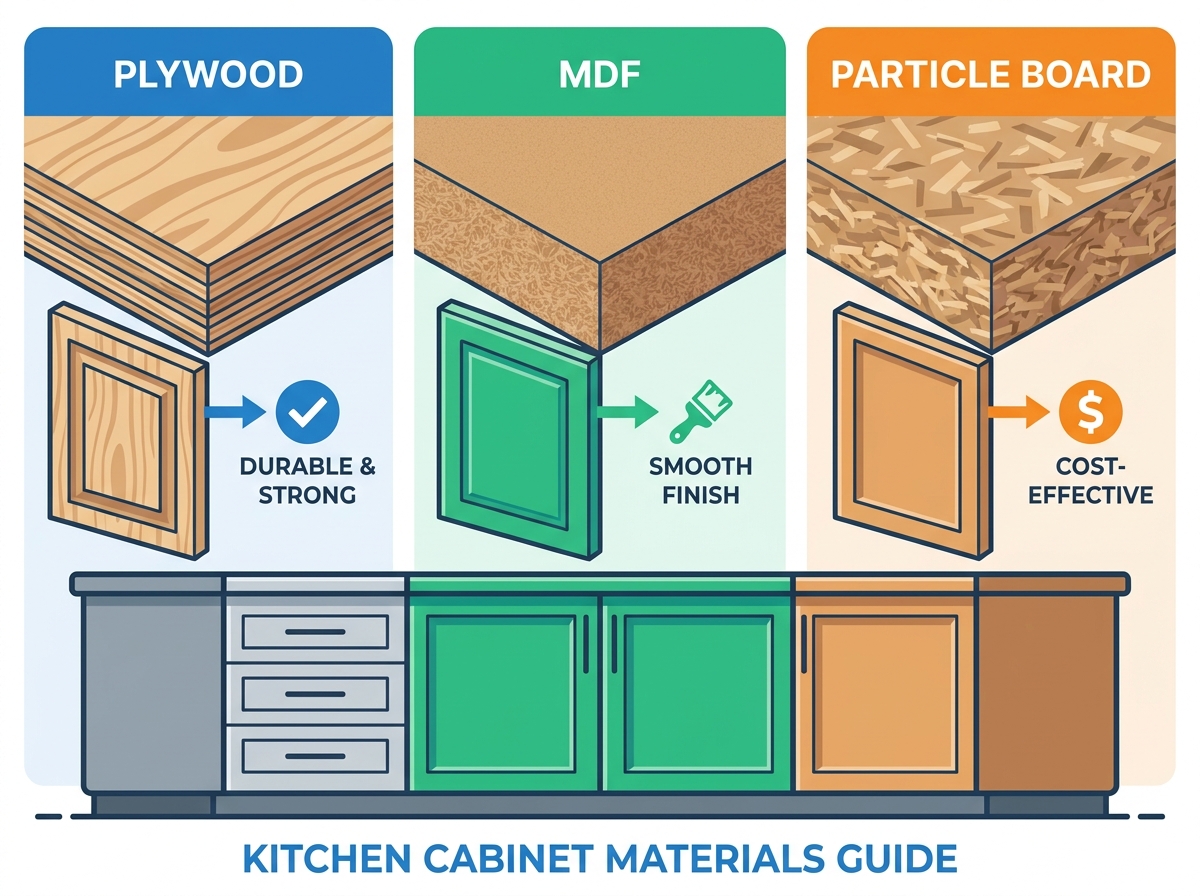
Choosing the right kitchen cabinet material depends on the cabinet component, intended use, and project budget. Plywood is widely used for cabinet boxes and structural components, MDF is a popular choice for painted cabinet doors, and particle board offers a cost-effective solution for laminate and melamine-finished cabinets.
Each material has distinct advantages in structural strength, moisture resistance, surface finishing, and manufacturing cost. Understanding these differences can help homeowners and project buyers make informed decisions about cabinet boxes, doors, shelves, and decorative panels.
This guide compares plywood, MDF, and particle board, including their material properties, performance, costs, and applications in modern kitchen cabinet construction.
Plywood: Offers strong structural performance and reliable screw-holding capacity, making it suitable for cabinet boxes, shelves, and demanding applications.
MDF: Provides a smooth, uniform surface for painted cabinet doors, drawer fronts, and decorative profiles.
Particle Board: Offers an economical and consistent substrate for melamine and laminate-finished kitchen cabinets.
Moisture Resistance: Plywood generally handles occasional moisture exposure better than standard MDF and particle board, although none of these materials is inherently waterproof.
Material Combinations: Using different materials for cabinet boxes, doors, and interior panels can balance durability, appearance, and manufacturing cost.
Kitchen cabinets consist of multiple components, each with different structural and finishing requirements. Cabinet boxes must support stored items and hardware, while doors and drawer fronts place greater emphasis on appearance and surface quality.
Understanding these differences helps explain why kitchen cabinet manufacturers frequently combine plywood, MDF, and particle board in the same project.
The cabinet box, also called the carcass, forms the main structure of a kitchen cabinet. It includes side panels, top and bottom panels, back panels, and internal supports.
Plywood is commonly used for durable cabinet boxes because of its structural properties and fastening performance. High-density particle board is another established option, particularly in modular and frameless cabinetry where panel consistency and engineered joinery are important.
Cabinet doors require suitable surface finishes, dimensional stability, and resistance to everyday handling.
MDF is frequently selected for painted cabinet doors because its fine-fiber structure supports smooth finishes and detailed routed profiles. Particle board is commonly used for flat-panel doors with melamine or laminate finishes, while plywood and wood-veneered panels offer options for natural wood appearances.
Kitchen cabinet shelves and drawer boxes must support dishes, cookware, and other stored items without excessive deformation.
Plywood is often preferred for heavily loaded shelves and drawer components. Particle board can also provide suitable support when panel thickness, span, joinery, and hardware are correctly specified.
The following table summarizes common kitchen cabinet material applications.
Cabinet Component | Common Materials | Main Consideration |
|---|---|---|
Cabinet boxes | Plywood, particle board, MDF | Strength, stability, cost |
Painted cabinet doors | MDF, solid wood | Smoothness and finish quality |
Laminate cabinet doors | Particle board, MDF | Surface consistency |
Cabinet shelves | Plywood, particle board, MDF | Load capacity and span |
Drawer boxes | Plywood, solid wood, engineered panels | Joint strength and daily use |
Decorative end panels | MDF, plywood, particle board | Appearance and finish |
Selecting materials according to cabinet components allows manufacturers to achieve practical performance without relying on one material throughout the entire kitchen.
Plywood, MDF, and particle board are engineered wood products manufactured using different wood structures and bonding processes. These differences influence their suitability for structural applications, decorative finishes, and cabinet assembly.
Plywood consists of thin wood veneer layers bonded together, generally with adjacent grain directions alternating. This cross-laminated construction provides strength, stiffness, and dimensional stability.
In kitchen cabinetry, plywood is commonly used for cabinet boxes, shelves, drawer components, and structural panels. Its layered construction also provides reliable fastening support for hinges, drawer slides, and cabinet connections.
However, plywood quality depends on veneer grade, core construction, adhesive bonding, and panel thickness. Lower-grade panels may contain internal voids or uneven layers that affect structural consistency.
Plywood can also require additional surface preparation for painted finishes because natural wood grain and veneer characteristics may remain visible.
Medium-density fiberboard (MDF) is manufactured from fine wood fibers bonded with resin under heat and pressure. Its uniform structure produces a smooth surface without visible natural wood grain.
This makes MDF particularly suitable for painted kitchen cabinet doors, drawer fronts, and decorative panels. Manufacturers can also machine detailed profiles and grooves using CNC equipment.
Standard MDF is sensitive to moisture when its surface or edges are unprotected. It is also relatively heavy, and fastener installation requires attention to pilot holes and appropriate hardware.
Moisture-resistant MDF grades are available for applications requiring improved moisture performance, although they are not waterproof.
Particle board is manufactured by compressing wood chips, particles, and processing residues with resin binders.
Its relatively uniform thickness and surface make it suitable for economical cabinet production, particularly for melamine-faced panels, laminate finishes, and modular kitchen cabinet systems.
High-quality furniture-grade particle board can provide reliable performance when used with appropriate panel thickness, edge-banding, and joinery.
Its primary limitations are moisture sensitivity and reduced fastening performance in some demanding applications. Exposed edges, damaged surfaces, and improperly installed hardware can increase the risk of panel deterioration.
Unlike plywood, particle board does not contain continuous wood veneer layers, so its structural properties depend heavily on panel density and manufacturing quality.
Material performance is one of the most important considerations when planning a kitchen renovation or custom cabinet project.
The following factors help distinguish how plywood, MDF, and particle board perform under typical kitchen conditions.
Kitchen cabinets are exposed to changing humidity, cooking steam, splashes, and occasional plumbing leaks.
Plywood generally provides greater tolerance of limited moisture exposure than conventional MDF and particle board. However, prolonged contact with water can still cause swelling, veneer separation, or adhesive deterioration.
MDF and particle board can absorb water through exposed edges, joints, or damaged surface finishes. Significant moisture penetration may lead to swelling and loss of structural integrity.
This makes material quality and moisture protection especially important around sink bases and dishwashers. Proper edge sealing, suitable surface finishes, and prompt leak repairs can help protect all three materials.
Plywood's layered construction generally provides good strength and screw-holding performance, making it suitable for demanding cabinet structures and hardware connections.
Particle board can support normal cabinet applications when properly engineered. However, shelf spans, panel density, thickness, and fastening methods must be appropriate for the expected loads.
MDF offers a consistent panel structure but is relatively heavy and may require specialized fastening methods in structural applications.
For heavily loaded shelves and wall-mounted cabinets, the overall construction is as important as the panel material. Cabinet backs, support rails, joinery, and mounting hardware must be designed for the intended load.
Different cabinet materials perform better with different surface finishes.
MDF is particularly suitable for painted cabinet doors because its smooth surface provides an even base for paint and detailed decorative profiles.
Hardwood veneer-faced plywood is commonly used when a natural wood appearance is required. It can be finished with suitable stains or clear coatings that highlight the wood grain.
Particle board is widely used with melamine and laminate finishes, providing smooth, consistent surfaces for modern flat-panel kitchen cabinets.
All three materials can be used with appropriate decorative surface treatments, depending on panel specifications and manufacturing processes.
Performance Factor | Plywood | MDF | Particle Board |
|---|---|---|---|
Structural strength | Generally high | Moderate | Depends on density and thickness |
Moisture tolerance | Generally better | Low for standard grades | Low for standard grades |
Screw-holding performance | Generally strong | More limited | More limited |
Surface smoothness | Depends on veneer grade | Excellent | Good with suitable finishing |
Painted finish | Requires preparation | Excellent | Requires suitable preparation |
Natural wood appearance | Available with hardwood veneer | Requires veneer | Requires veneer |
Laminate compatibility | Good | Good | Good |
Typical applications | Cabinet boxes, shelves | Painted doors, decorative panels | Melamine cabinets, modular components |
Each material has distinct advantages. Plywood is often preferred for structural components, MDF for painted finishes, and particle board for economical laminate and melamine cabinet construction.
For a more detailed comparison of structural performance, moisture resistance, and long-term value between these two cabinet materials, read our Plywood vs Particle Board Kitchen Cabinets: Which Is Better? guide.
The cost of kitchen cabinet materials depends on panel grade, thickness, surface finishing, manufacturing complexity, and the components being produced.
Particle board is generally an economical choice for standard cabinet boxes and laminate-finished components. MDF provides value in painted doors and decorative panels, while plywood often carries a higher material cost for structural applications.
Particle board supports efficient large-scale production because its manufacturing process uses wood particles and processing residues.
MDF costs vary according to panel specifications and machining requirements. Detailed routed door profiles and painted finishes can increase the overall manufacturing expense.
Plywood typically requires a higher material investment, particularly for cabinet-grade panels with quality veneers and reliable core construction.
However, the price of a complete kitchen cabinet system also depends on hardware, finishes, dimensions, accessories, and installation.
Initial material cost is only one part of a cabinet's long-term value.
Plywood may offer advantages in areas exposed to moisture or heavy use because of its structural characteristics. MDF provides an effective substrate for painted components, while particle board can offer good value in properly protected storage applications.
Repair costs should also be considered. For example, replacing a severely water-damaged sink base cabinet may involve removing plumbing connections and adjacent components.
Using suitable materials in moisture-prone and heavily loaded areas can help reduce the risk of premature replacement.
A kitchen does not necessarily require the same material for every cabinet component.
Combining plywood cabinet boxes, MDF painted doors, and melamine-faced particle board panels can balance structural performance, appearance, and manufacturing efficiency.
Material quality, workmanship, and hardware specifications remain essential regardless of the selected combination. A well-constructed engineered wood cabinet may perform better than a poorly manufactured cabinet using a more expensive substrate.
Beyond the core material, cabinet quality depends on manufacturing standards, hardware compatibility, and protective finishing.
These considerations influence both everyday performance and long-term maintenance requirements.
Plywood, MDF, and particle board use adhesives during manufacturing. Depending on the resin system and product specifications, certain panels may release formaldehyde.
When purchasing kitchen cabinets, buyers should review applicable emissions documentation, including:
CARB Phase 2: California formaldehyde emission requirements for regulated composite wood products.
TSCA Title VI: US federal formaldehyde emission requirements for regulated composite wood products.
NAUF: A designation indicating that no urea-formaldehyde resin was intentionally added during manufacturing.
These terms are not interchangeable, and NAUF does not necessarily mean zero formaldehyde emissions.
Suppliers should provide relevant compliance information for the materials used in cabinet production.
Hinges, drawer slides, and cabinet connectors must be compatible with the selected panel material.
Plywood generally provides reliable fastening support. MDF and particle board require suitable screws, pilot holes, and joint designs to maintain hardware performance.
Confirmat screws, dowel connections, and appropriate mounting systems are commonly used in engineered wood cabinet construction.
Correct installation helps prevent loose hinges, damaged screw holes, and drawer misalignment.
Edge-banding protects exposed panel edges and contributes to the finished appearance of kitchen cabinets.
For MDF and particle board, properly applied edge-banding is particularly important because exposed cores can absorb moisture and swell.
Common edge-banding materials include PVC and ABS, while EVA and PUR adhesives are widely used in cabinet manufacturing.
PUR-bonded edge-banding can offer improved heat and moisture resistance compared with conventional EVA systems, depending on the product and application process.
However, no edge-banding system makes the entire cabinet waterproof. Proper sealing around sinks, dishwashers, and plumbing cutouts remains essential.
The best kitchen cabinet material depends on how each component will be used.
Plywood is generally suitable for structural cabinet boxes and demanding storage applications. MDF offers excellent finishing properties for painted doors and decorative panels, while particle board provides an economical substrate for laminate and melamine cabinetry.
For many custom kitchen projects, combining these materials is more practical than selecting a single substrate throughout the entire kitchen.
Before finalizing a cabinet order, review material grades, panel thickness, moisture protection, hardware specifications, surface finishes, and overall manufacturing quality.
Choosing the right material for each component helps balance kitchen cabinet durability, appearance, and project cost.
The best material depends on the cabinet component and intended use. Plywood is commonly preferred for structural cabinet boxes, MDF for painted doors, and particle board for economical melamine and laminate-finished cabinetry.
Plywood is generally better suited to demanding structural applications because of its strength and fastening performance. MDF is often preferable for painted cabinet doors because of its smooth, uniform surface and machining flexibility.
MDF is commonly preferred for painted doors and decorative panels, while particle board is widely used for cost-effective cabinet boxes and laminate components. Both materials can perform well when their specifications match the intended application.
Yes. MDF can be used for cabinet boxes when panel thickness, joinery, hardware, and moisture protection are properly designed. However, plywood and high-density particle board are common alternatives for many structural cabinet applications.
No. Plywood generally tolerates occasional moisture exposure better than standard MDF and particle board, but prolonged wetting can still cause swelling and delamination. Surface finishing and edge protection remain important.
Their lifespan depends on panel quality, installation, daily use, and moisture exposure. Well-manufactured MDF and particle board cabinets can provide many years of service in suitable indoor conditions.
MDF and particle board can be suitable for indoor cabinetry when they meet applicable formaldehyde emission requirements. Buyers should review relevant compliance documentation, such as CARB Phase 2 or TSCA Title VI, where applicable.
Yes. Many kitchen cabinet systems combine plywood structural components, MDF painted doors, and melamine-faced particle board panels to balance durability, appearance, and manufacturing cost.
The right kitchen cabinet materials can make a significant difference in durability, appearance, and long-term performance. Whether your project requires plywood cabinet boxes, MDF painted doors, or particle board with laminate finishes, material specifications should match your design and functional requirements.
CestlaV Home offers custom kitchen cabinet solutions with different material, finish, door style, and configuration options for residential and commercial projects.
Explore our Custom Kitchen Cabinets to learn more about available cabinet designs and customization options.