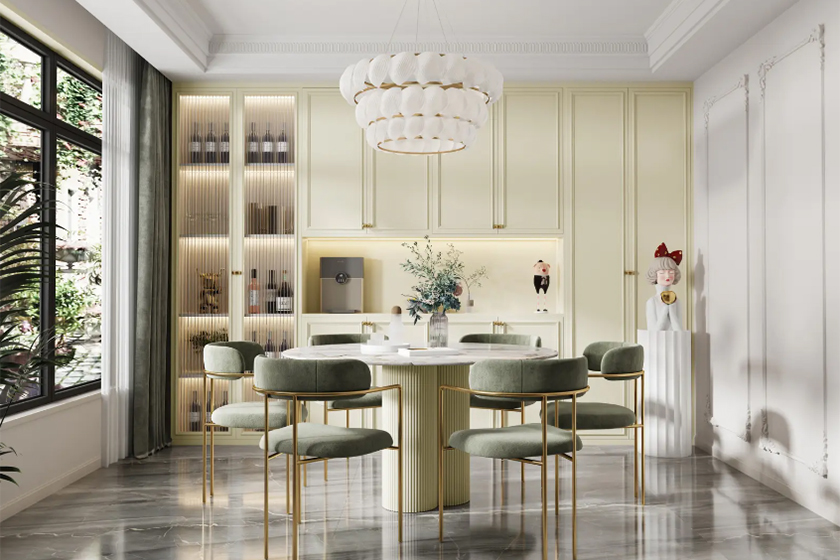
What Makes Lacquer Finished Cabinets Unique?
Lacquer finished cabinets are known for their luxurious appearance, smooth texture, and immaculate surface quality. Unlike traditional laminates or melamine, lacquer delivers a premium finish with exceptional color depth and visual clarity. The surface is polished to perfection, reflecting light beautifully in high-gloss versions or creating a velvety, elegant texture in matte finishes.
This unique aesthetic makes lacquer cabinetry a popular choice in modern, minimalist, and high-end kitchen designs.
⭐ Featured Lacquer Finished Cabinet Products
![]()
| Product Name | Key Features | Materials & Specs | Applications |
| Living and Dining Room Spaces – H505 | • Modern lacquer finish
• Smooth seamless surfaces
• Versatile storage layout
• Ideal for open-concept homes | Material: MDF + lacquer
Finish: Gloss / matte options
Customization: Sizes, layout, colors | • Living room wall cabinets
• Dining room storage
• Integrated home solutions |
| Living and Dining Room Spaces – H515 | • Premium lacquer finish
• Elegant minimalist design
• Excellent color depth
• Smooth high-end textures | Material: MDF + multi-layer lacquer
Finish: Custom colors
Customization: Dimensions, accessories | • Modern living rooms
• Luxury residential interiors
• Entertainment storage units |
| Living and Dining Room Spaces – H538 | • High-gloss or matte lacquer
• Clean line aesthetics
• Practical functional layout | Material: Lacquered MDF
Finish: Gloss / matte
Options: Handleless design, soft-close | • Dining room cabinets
• Open-plan living spaces
• Interior project installations |
| Living and Dining Room Spaces – H501 | • Stylish lacquer appearance
• Durable finish with smooth texture
• Perfect for coordinated home themes | Material: Lacquer MDF panels
Finish: Matte / gloss optional
Customization: Sizes & colors available | • Home entertainment walls
• Dining spaces
• Custom-built residential projects |
How Lacquer Cabinets Are Made: Multi-Layer Premium Paint Technology?
Lacquer cabinets undergo a meticulous multi-step finishing process that defines their superior look and performance. The typical manufacturing workflow includes:
Surface preparation and sanding for perfect smoothness
Primer application to stabilize the substrate
Multiple layers of color lacquer spraying
UV or heat curing to harden the coating
Polishing or matting treatment for gloss or matte effects
Final protective coating for enhanced durability
This highly controlled process results in a flawless finish that is impossible to achieve with low-cost coatings or DIY applications.
Why MDF Is the Ideal Material for Lacquer Kitchen Cabinets?
MDF (Medium Density Fiberboard) is the preferred substrate for lacquered cabinetry due to its:
Extremely smooth fiber composition—perfect for achieving uniform paint finishes
Dimensional stability—resists expansion and warping better than solid wood
Excellent adhesion properties—supports multi-layer lacquer coatings
Seamless edges—eliminates visible lines and imperfections
While solid wood may be ideal for stained finishes, MDF is unmatched for producing premium lacquer surfaces.
Types of Lacquer Finishes: PU, PE, UV, and NC
Different lacquer technologies offer different advantages:
PU (Polyurethane Lacquer)
UV Lacquer
PE (Polyester Lacquer)
NC (Nitrocellulose Lacquer)
Offering multiple lacquer types allows customers to select finishes based on budget, durability needs, and desired style.
Advantages of Lacquer Cabinets in Modern Interior Design
Lacquer's combination of aesthetics and performance makes it a favorite among designers and homeowners:
Unmatched visual elegance—mirror-like gloss or sophisticated matte
Rich, deep color expression in any shade
Flawless surface uniformity with no texture irregularities
Highly customizable across finishes, colors, and door styles
Excellent light reflection for brighter, more open kitchens
Durable and easy to clean for daily use
When paired with modern layouts, lacquer cabinetry elevates the overall luxury of the home.
Important Considerations Before Choosing Lacquer Cabinets
Lacquer is a premium finish and requires professional understanding. Customers should be aware of:
Higher sensitivity to scratches vs. laminate or melamine
High-gloss surfaces show fingerprints and smudges more easily
Improper curing can cause peeling—choose experienced manufacturers only
Not ideal for heavy-impact areas without added protection
Costs more due to labor-intensive production
These factors ensure customers make well-informed decisions while appreciating the value behind lacquer craftsmanship.
Where Lacquer Cabinets Perform Best
Lacquer cabinetry excels in environments where aesthetics and design impact matter:
Modern luxury kitchens
Minimalist or contemporary interior styles
Show homes and display units
High-end apartments and villas
Office receptions and feature walls
Boutique retail environments
The sleek look of lacquer elevates any space where visual quality is a priority.
Lacquer vs Other Cabinet Finishes: Which One Fits Your Project?
| Feature | Lacquer Finish | Melamine | Thermofoil | Laminate |
| Visual Luxury | ★★★★★ | ★★ | ★★ | ★★ |
| Color Customization | Unlimited | Limited | Limited | Medium |
| Gloss Potential | Exceptional | Basic | Moderate | Good |
| Scratch Resistance | Moderate | High | Low | High |
| Heat Resistance | Moderate | Good | Poor | Good |
| Maintenance | Easy | Very Easy | Easy | Easy |
| Price Level | High | Low | Medium | Medium |
| Best For | Luxury kitchens & statement designs | Budget/moderate projects | Low-budget kitchens | High-traffic spaces |
This comparison helps buyers instantly identify whether lacquer is the right fit for their style and budget.
Recommended Color & Style Directions for Lacquer Kitchens
Lacquer works exceptionally well with bold, clean, and contemporary styles. Popular design trends include:
High-Gloss White – timeless luxury & bright spaces
Matte Black – ultra-modern sophistication
Navy Blue Gloss – elegant and high-end
Soft Grey Matte – Scandinavian minimalism
Emerald Green Gloss – statement luxury kitchens
Metallic Lacquer – futuristic premium designs
You may also encourage customers to request custom RAL / Pantone colors for project-specific palettes.
Custom Manufacturing, OEM Solutions & Project Support
We support extensive customization and professional project execution:
Custom cabinet sizes & layouts
Gloss, matte, metallic, or textured lacquer options
Soft-close hardware & premium internal accessories
Matching panels, trims, and integrated handles
OEM/ODM services for international brands
Large-scale production for real estate & hospitality projects
Whether for luxury homes or commercial developments, our lacquer cabinetry delivers consistent high-end results.
Lacquer Cabinet FAQ
Do lacquer cabinets scratch easily?
High-quality lacquer is durable but can scratch under heavy impact. Matte lacquer hides scratches better than high-gloss.
Do lacquer cabinets yellow over time?
Premium UV-resistant lacquers are designed to prevent yellowing.
Are lacquer cabinets suitable for kitchens?
Yes. They perform well when not exposed to extreme heat or humidity.
Can I customize the color of lacquer cabinets?
Absolutely. We provide custom color matching using RAL, Pantone, or designer samples.
Are lacquer cabinets easy to clean?
Yes—just use a soft cloth and mild cleaner. Avoid abrasives to maintain the shine.
What is a lacquer finish on cabinets?
A lacquer finish is a high-performance coating created by spraying multiple layers of lacquer—primer, color coats, and topcoat—onto a cabinet surface. Once cured, it forms a smooth, hard, and uniform finish available in high-gloss, matte, or satin styles. Lacquer provides rich color depth, a premium look, and a seamless modern appearance that is highly valued in contemporary kitchen design.
What are the disadvantages of lacquer finish?
Lacquer has several limitations homeowners and designers should consider:
Prone to scratching under heavy impact
High-gloss lacquer shows fingerprints more easily
UV exposure may affect color if low-quality lacquer is used
Requires controlled factory application; DIY results are poor
Not as heat-resistant as some other finishes
Difficult to repair perfectly once damaged
Despite these drawbacks, lacquer remains a top choice for premium aesthetics.
How long does lacquer last on cabinets?
A professionally applied lacquer finish typically lasts 10–20 years, depending on:
High-quality PU or UV-cured lacquer can last even longer with minimal fading or peeling.
What is a lacquer finish?
Lacquer is a solvent-based or water-based coating that dries into a durable, hard, and visually smooth film. It is used on cabinets, furniture, doors, and decorative interiors to achieve a flawless surface with high clarity and depth. It differs from paint because lacquer bonds more tightly, levels more smoothly, and provides a more luxurious appearance.
Is lacquer or polyurethane better for kitchen cabinets?
Both are excellent, but they excel in different ways:
Lacquer:
Superior smoothness and visual clarity
Exceptional gloss or matte uniformity
Easier to repair minor scratches
Better for custom colors and modern designs
Polyurethane:
For high-end modern kitchens, lacquer is preferred. For ultra-tough surfaces or rustic wood, polyurethane is better.
What is the lifespan of lacquer?
Lacquer finishes typically have a lifespan of 10–20+ years with proper care. Premium PU or UV-cured lacquers offer the longest durability and maintain their color and sheen far better than standard paint.
Does lacquer need a primer?
Yes. Lacquer applications require a special lacquer primer (also called sealer primer). This helps:
Skipping primer results in uneven finish and poor durability.
How to tell if cabinets are lacquered?
You can identify lacquer cabinets by observing:
High-gloss or ultra-smooth matte finish
No visible texture—surface is completely flat
Rich color depth
Very smooth edges around profiles
A soft tapping sound indicating MDF + lacquer layers
If you rub a small area with acetone, lacquer may soften slightly—paint will not.
What do professionals use to spray kitchen cabinets?
Professionals typically use:
HVLP (High-Volume, Low-Pressure) spray systems
Airless sprayers for large projects
Industrial lacquer curing booths for baking and UV curing
These tools ensure a dust-free, glass-like finish not achievable with rollers or brushes.
Why use lacquer instead of polyurethane?
Designers often choose lacquer because it offers:
Superior aesthetic quality
Exceptionally smooth leveling
Deeper and richer color tones
Faster drying and curing
Better color customization (RAL / Pantone)
Seamless modern appearance
Polyurethane is stronger, but lacquer is visually superior.
What are the disadvantages of lacquer?
Key drawbacks include:
Vulnerability to scratches
Lower heat tolerance compared to PU
Harder to repair perfectly
Shows smudges on high-gloss finishes
More expensive due to labor-intensive spraying
However, these are offset by its unbeatable premium appearance.
Is it better to roll or spray paint kitchen cabinets?
Spraying is significantly better for lacquer finishes because:
Lacquer must atomize properly
Rolling leaves texture and bubbles
Spray creates a uniform professional coating
Achieves the glossy or matte clarity lacquer is known for
Lacquer should always be sprayed, not rolled.
Can I apply lacquer without sanding?
No. Sanding is essential.
Each coat of lacquer must be:
Applied
Dried
Lightly sanded
Re-coated
This process ensures adhesion, smoothness, and long-term durability.
Does lacquer need a sealer?
Yes. Lacquer sealing coats are used to:
A lacquer system typically includes sealer + multiple color coats + topcoat.
Which is better, varnish or lacquer?
Lacquer is better for:
Varnish is better for:
For modern cabinet doors: lacquer wins.
Does lacquer waterproof wood?
Lacquer creates a moisture-resistant seal, but it is not fully waterproof.
It protects cabinets from daily humidity and spills, but:
Flooding
Standing water
Poor edge banding
can still cause damage to the substrate beneath.
What are the drawbacks of lacquer?
Drawbacks include:
Sensitive to scratches
High-gloss shows fingerprints
More expensive due to production method
Requires professional spraying
Limited DIY repair options
Despite this, it remains one of the most luxurious cabinet finishes available.
What is the best finish for wood cabinets?
For modern designs, lacquer is arguably the best finish due to its clarity and smooth texture.
Other top contenders include:
Polyurethane (maximum durability)
Conversion varnish (commercial-grade strength)
Oil-based varnish (traditional warmth)
However, for premium modern appearances, lacquer is unmatched.
Is it better to use lacquer or polyurethane?
Use lacquer when:
Use polyurethane when:
You need extreme durability
Cabinets will face heavy wear
You prefer natural wood aesthetics
Both are excellent but serve different design priorities.