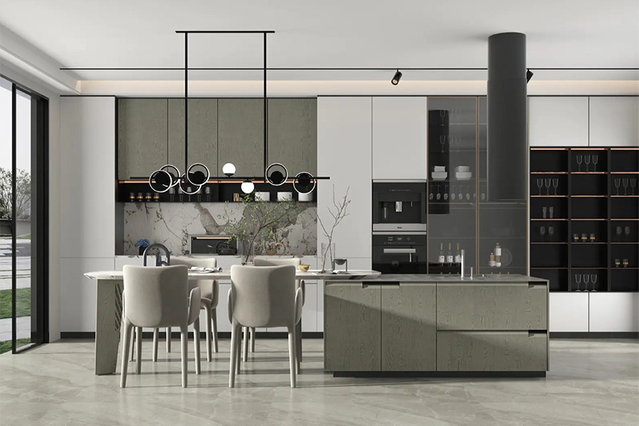
Wood Veneer Cabinets – Premium Design, Natural Beauty, and Modern Craftsmanship
Wood veneer cabinets offer a refined balance between natural aesthetics and modern engineering. They bring the warmth and texture of real wood while remaining lightweight, stable, and highly customizable — making them one of the most desirable choices for contemporary kitchens and interior projects.
At Cestlavhome, our wood veneer cabinets are crafted with meticulous attention to grain matching, substrate stability, and finishing consistency. Whether used in kitchens, living rooms, closets, or office spaces, wood veeer delivers the timeless charm of solid wood with greater flexibility and exceptional value.
Key Advantages:
✓ Natural wood grain patterns & textures
✓ Eco-friendly thin veneer over sustainable cores
✓ Custom stains from light natural to espresso finishes
✓ Resistant to temperature/humidity changes
✓ Coordinates with our wood veneer doors and wall panels.
Why Wood Veneer Cabinets Make Sense?
Real Wood Aesthetic, Smarter Cost
Experience the timeless visual appeal of genuine wood—such as oak, walnut, or maple—without the high price tag of solid wood. Wood veneer uses thin layers of real timber over engineered core materials like MDF or plywood, delivering the beauty of natural grain at better efficiency and cost-efficiency.
Stable & Durable
Unlike solid wood, which can warp or shift with temperature and humidity, wood veneer stays remarkably stable. Its engineered backing minimizes expansion and contraction, making it ideal for kitchens.
Sustainable Materials
Veneer maximizes the yield from a single log, allowing many thin slices to be used instead of solid panels—supporting responsible sourcing and reducing waste.
Design Flexibility
With wood veneer, you have vast creative freedom. Choose from wood species such as oak, walnut, maple, cherry, or hickory. You can select different grain cuts like quarter-sawn or rift-cut to tailor texture and visual depth.
Easy to Maintain & Refurbish
Veneer surfaces are simple to clean and, in most cases, can be lightly sanded and refinished without compromising structural integrity.
Features at a Glance
| Feature | Benefit |
| Real wood grain veneer | Achieves authentic beauty at a more affordable price |
| Engineered core backing | Resists warping—ideal for moist or changing environments |
| Wide material selection | Choose from oak, maple, walnut, cherry, hickory, and more |
| Flexible grain finishes | Customize with quarter, rift, or plain cuts for distinct visual appeal |
| Eco-conscious choice | Efficient wood usage supports sustainability |
| Durable & maintainable | Easy to clean, and minor damage can be resurfaced or refreshed |
Wood Veneer vs Solid Wood Cabinets – What’s the Difference?
| Feature | Wood Veneer Cabinets | Solid Wood Cabinets |
| Material | Thin real-wood layer on engineered panel | Entirely hardwood |
| Stability | Highly stable; minimal warping | Can warp or swell with humidity |
| Design Options | Seamless large panels, book-matching | Natural variations; limited panel width |
| Cost | More affordable | Significantly higher price |
| Maintenance | Easy to clean, stable finish | Requires more care |
| Eco-Friendliness | Uses less timber | Consumes more hardwood |
| Ideal For | Modern, minimalist, large kitchens | Traditional, luxury hardwood projects |
Wood Veneer Options
1. Design Inspiration
✪ Seamless Modern Kitchens
Light-toned denser veneers (like maple or rift-sawn oak) make compact spaces feel brighter and more cohesive—great for minimalistic, modern designs.
✪ Balanced Contrast
Pair darker veneer finishes like walnut with matte hardware to create a modern, tactile luxury feel—perfect for open-plan or custom layouts.
✪ Cabinet configurations tailored to your space
✪ 50+ veneer species and stain options
✪ Professional 3D kitchen design preview
2. Veneer Species Options
| Species | Color Tone | Grain Characteristics | Best For |
| White Oak | Light, neutral | Straight grain | Scandinavian, Japandi |
| Walnut | Deep brown | Rich, flowing grain | Luxury contemporary |
| Maple | Pale cream | Soft grain | Minimalist, clean interiors |
| Cherry | Warm red-brown | Fine grain | Classic kitchens |
| Hickory | Varied | Bold grain | Rustic or farmhouse |
| Ash | Light beige | Linear grain | Modern, textured designs |
2. Substrate & Core Options
| Core Material | Strength | Cost | Notes |
| Plywood | High | Medium | Best overall performance |
| MDF | Medium | Low | Ideal for smooth finishes |
| Particle Board | Lower | Lowest | Cost-effective projects |
3. Surface Finish Options
| Finish Type | Appearance | Benefits |
| Matte | Soft, contemporary | Hides fingerprints |
| Satin | Light sheen | Most popular |
| High-Gloss | Reflective | Modern, premium look |
| Open-Pore | Textured wood feel | Authentic natural touch |
| Stained Veneer | Color enhanced | Grain definition increases |
| Clear Coating | Natural color preserved | Clean, minimalist look |
FAQ — Wood Veneer Cabinets
Can wood veneer cabinets resist moisture?
Yes—when properly sealed with quality lacquers or UV-cured coatings, they offer solid moisture resistance. Prompt cleanup of spills helps maintain their finish.
How do they compare to laminate or solid wood?
Laminate lacks real texture and authenticity. Solid wood strongly resists wear but is expensive and prone to warping. Veneer offers a balance: real wood aesthetics, improved stability, and better value.
Can wood veneer cabinets be refinished?
Yes—though limited by the veneer thickness, they can be lightly sanded and recoated. Always test in an inconspicuous area or consult a professional to prevent damage.
Are high-end finishes achievable with veneer?
Absolutely. Whether staining or lacquering, veneer accepts a wide array of finishes and can be paired seamlessly with solid wood trims for a cohesive luxury look.
Is wood veneer good for kitchen cabinets?
Yes — wood veneer is an excellent material for kitchen cabinets. It provides the beauty of real wood grain while offering better structural stability than solid hardwood. Because veneer panels are bonded to an engineered core (like plywood or MDF), they resist warping, shrinking, and cracking in humid kitchen environments. Veneer is also lighter, more sustainable, and allows large seamless surfaces that solid wood cannot achieve.
Are veneer cabinets high end?
Absolutely. Many luxury European cabinet brands (e.g., Poliform, Siematic, Boffi) use veneer as their primary surface material because it allows:
High-end modern and minimalist kitchens often rely on veneer because it creates a premium, architectural look.
Which is better, melamine or veneer?
It depends on your priorities:
| Feature | Wood Veneer | Melamine |
| Appearance | Natural, high-end, real wood look | Printed wood texture, more artificial |
| Durability | Stable, repairable, long-lasting | Very scratch-resistant, highly durable |
| Cost | Higher | More budget-friendly |
| Customization | Unlimited stains, patterns | Limited to factory finishes |
| Ideal Use | Premium kitchens | Rental units, budget builds |
Verdict:
For luxury kitchens, veneer is superior.
For budget projects, melamine is more cost-efficient.
What are the disadvantages of wood veneer?
Wood veneer has a few limitations:
It can scratch more easily than melamine or laminate.
Requires careful sealing to protect against moisture.
Cannot be sanded repeatedly like solid hardwood.
Very cheap veneers (not yours) may peel if poorly manufactured.
High-quality veneer from engineered cores ages well and avoids most issues.
What is cheaper, laminate or veneer?
Laminate is typically cheaper.
Laminate is made from synthetic layers and printed patterns.
Veneer is made from real harvested wood, which increases material cost.
However, veneer provides a more upscale appearance and significantly increases perceived home value.
Is laminate or veneer better for kitchen cabinets?
Both materials are suitable, but for different kitchens:
Choose veneer if you want premium natural aesthetics, warmth, and real wood grain.
Choose laminate if you want maximum durability with minimal budget.
Most mid- to high-end kitchens choose veneer over laminate due to design flexibility.
How long do veneer cabinets last?
With proper care, high-quality veneer cabinets can last 20–25+ years.
Their lifespan depends on:
substrate quality (plywood > MDF > particle board)
finishing (UV coatings, lacquer, polyurethane)
humidity control
daily wear and tear
Many luxury veneer kitchens last 30 years.
What are the three grades of cabinets?
Industry-wide, cabinets are categorized into:
Stock Cabinets
Prebuilt, fixed sizes, lowest cost.
Semi-Custom Cabinets
Adjustable sizing and finishes, great mid-range option.
Custom Cabinets
Built to order, any size/material, premium pricing — veneer is often used here due to grain matching.
What is the best kitchen cabinet wood?
For solid wood: maple, oak, cherry, walnut.
For veneer: white oak veneer and walnut veneer are top choices due to their stability and timeless appeal.
Veneer paired with a plywood core is considered the highest-performance structure for modern kitchens.
What is the 4–8–10 rule for veneers?
This design guideline helps ensure visually consistent grain patterns:
4 ft: typical veneer sheet width
8 ft: standard veneer sheet length
10 ft: maximum seamless run desirable for large installations
This rule helps designers plan book-matching and grain flow for kitchen walls or island panels.
What are the negatives of veneers?
Key limitations include:
Surface is thinner than solid wood
Requires gentle cleaning
Not ideal for repeated deep sanding
Poor-quality veneer may chip if not sealed properly
High-grade veneers used in cabinet manufacturing avoid most of these concerns.
What is the lifespan of wood veneer?
On average 20–30 years, depending on:
veneer thickness
UV protection
kitchen humidity
cleaning habits
Architectural-grade veneers last the longest.
What is the 1–3 rule for cabinets?
A common design guideline stating the three major storage zones:
It helps determine where cabinets should be placed to optimize workflow.
How to tell if cabinets are high quality?
Look for these indicators:
Plywood core, not particle board
Full-extension drawer glides
Soft-close hinges
Dovetail drawer boxes
Thick, uniform veneer layer
Smooth grain matching
Consistent finish without ripples
Premium veneer cabinets score highly in every category.
What are the best kitchen cabinets for the money?
The best value category is:
Plywood-core wood veneer cabinets
They offer:
This is why many modern homes choose veneer.
Is $10,000 enough for a kitchen remodel?
For small kitchens with veneer fronts and standard hardware, $10,000 can cover basic cabinetry, but not full remodels.
Most complete kitchen renovations range from $20,000–$45,000.
Are wood cabinets coming back in 2025?
Yes — natural wood tones are one of the biggest design trends for 2025 and 2026.
Especially popular:
Minimalist “warm wood modern” styles are replacing stark white kitchens.
What is the best material to use for kitchen cabinets?
Based on durability + aesthetics + cost:
Plywood-core veneer cabinets are considered the best-balanced material choice.
They outperform solid wood in stability and outperform melamine in appearance.
What is better, veneer or laminate?
Veneer tends to be the preferred option for high-end or long-term installations.
Start Your Cabinet Upgrade with Confidence
With CestlaV Home's wood veneer cabinets, you get:
The timeless elegance of real wood
Practical durability in demanding kitchen environments
Tailored style and sustainable design
Exceptional value and long-term performance
Contact us now to explore wood species, finishes, and layouts—or request samples to bring your vision to life.